


 InvestSMART
16 October 2018
InvestSMART
16 October 2018
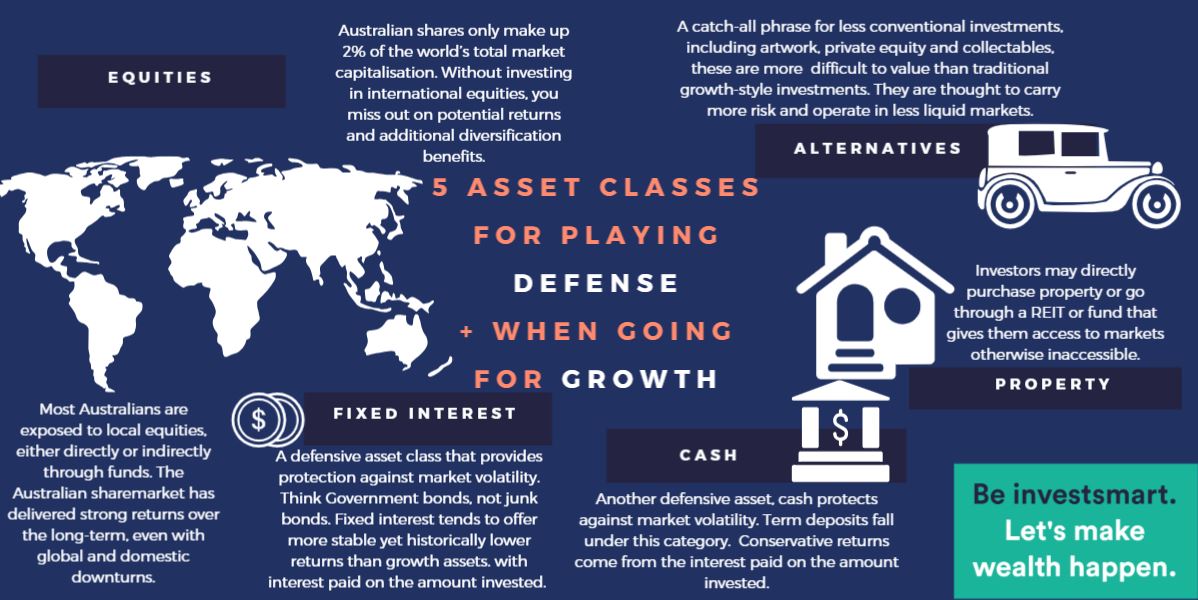
Once you know your objectives, your time horizon and your risk profile, you can then determine asset allocation. Your investing goal should be maintaining a diversified portfolio, and achieving this means allocating different amounts across different asset classes including equities, fixed interest, property, alternatives and cash. All the while, you should keep your life cycle stage, current situation and goals top of mind.
At some stage, that basket is bound to crack.
Over the long-term, no singular asset class is guaranteed to deliver consistent returns. This makes diversification important.

Unfortunately, when it comes to investing, most Australians will focus on their home turf only and overlook opportunities abroad. Therefore, it’s nothing personal when we say Australians tend to be ‘overweight’ domestic equities, property and cash, and ‘underweight’ international markets. If Australia has such a strong economy, why does this even matter? Well, volatility and downturns are par for the course in any market, and you’re probably always missing out on better gains to be experienced elsewhere.
Over the past 70 years, every single asset class has experienced a period of outperformance against its peers, before encountering a setback to underperform. It’s natural for markets to have winners and losers. It’s difficult to pick these. Some eggs will hatch golden, and others rotten.
Keeping several baskets, or diversifying across asset classes, will ultimately reduce risk, improve returns and preserve wealth.
Of course, what works for some won’t work for all.
Asset allocation will depend on your risk profile and objectives, and your personal goalposts are forever changing. That’s why reviewing and rebalancing your portfolio on a regular basis is necessary.
For example, as a younger investor, you may have a longer horizon to achieve your goals, and therefore, years to endure volatility. Growth assets will probably be more your thing. You can probably afford to win some and lose some, and take on more risk. But as an older investor, you should probably be a little more conservative and lean on defensive assets, as you’re more than likely relying on your savings for income.
In this battle, it’s impossible to pick a consistent winner. Keep the company of both.
Traditionally, defensive assets are lower risk and lower return. Think cash, fixed interest and some equities. Volatility isn’t in their nature. In all hope, they provide a regular and steady income stream, while preserving principle. In a down market, they tend to do better. Above all though, easy does it with defensive assets, and they are more about preserving wealth than going for growth.
That’s where growth assets kick in, like equities, property and alternatives. Growth assets generally outperform in up markets, and they should ultimately provide returns in the form of something called capital growth. Over time, the value of the asset should ultimately go up – but it may be a rocky road along the way.
Tailwinds are great, headwinds not so. Getting the right balance of defensive and growth assets is important, and it will all depend on your risk tolerance and objectives.
If it’s backed by a Nobel Prize winning economist, you know the theory must be good.
Harry Markowitz developed Modern Portfolio Theory in 1952 to demonstrate how you can combine different assets with different volatilities to minimise overall portfolio volatility. It still holds up today.
Correlation is the name of the game here. You should choose assets with low correlation, so when one asset goes down, the other is more likely to go up. The golden egg outshines the rotten egg. Determining the exact balance is a personal matter, but this way, the balance of your portfolio should ultimately be in your favour.
To find out more about InvestSMART and their insights, visit their website.
Laura Daquino is a Sub-Editor and Finance Journalist at InvestSMART Group (AFSL 282288). This article contains general investment advice only. It has been prepared without having regarded to or taking into account any particular investor’s objectives, financial situation and/or needs. All investors should therefore consider the appropriateness of the advice, in light of their own objectives, financial situation and/or needs, before acting on the advice. The article was originally published on 21 September 2018.



 CommSec
20 August 2018
Trying to choose a company to invest in can be overwhelming, especially when you’re new to shares. Here are seven tips on where you can start your research.
Read more
 CommSec
20 August 2018
How do you choose shares when there are over 2,200 companies trading on the ASX? Try starting your research with a sharemarket category like market sector, industry, or market capitalisation.
 CommSec
3 August 2018
Sticking to an investment plan is the key to success for many investors. We look at why planning is so important, and how to write an investment plan that works for you.
Read more
Start trading today with Australia's leading online broker
Commonwealth Securities Limited ABN 60 067 254 399 AFSL 238814 ("CommSec") is a wholly owned, but non-guaranteed, subsidiary of the Commonwealth Bank of Australia ABN 48 123 123 124 AFSL 234945 ("the Bank") and both entities are incorporated in Australia with limited liability.
This information is directed and available to and for the benefit of Australian residents only and is not a recommendation or forecast.
Information presented in this article is not advice and has been prepared without taking account of the objectives, financial or taxation situation or needs of any particular individual. Any prices or securities used in the examples in this presentation are for illustrative purposes only and should not be considered as a recommendation to buy, sell or hold. Past performance is not indicative of future performance. For this reason, any individual should, before acting on this information, consider the appropriateness of the information, having regards to the individual's objectives, financial or taxation situation and needs, and, if necessary, seek appropriate professional advice. The article is written by external companies that are not a member of the Commonwealth Bank of Australia Group of Companies (the CBA Group) does not represent an endorsement, recommendation, guarantee or advice in regard to any matter. The CBA Group does not accept any liability for losses or damage arising from any reliance on external companies and their products, services and material.